
Description
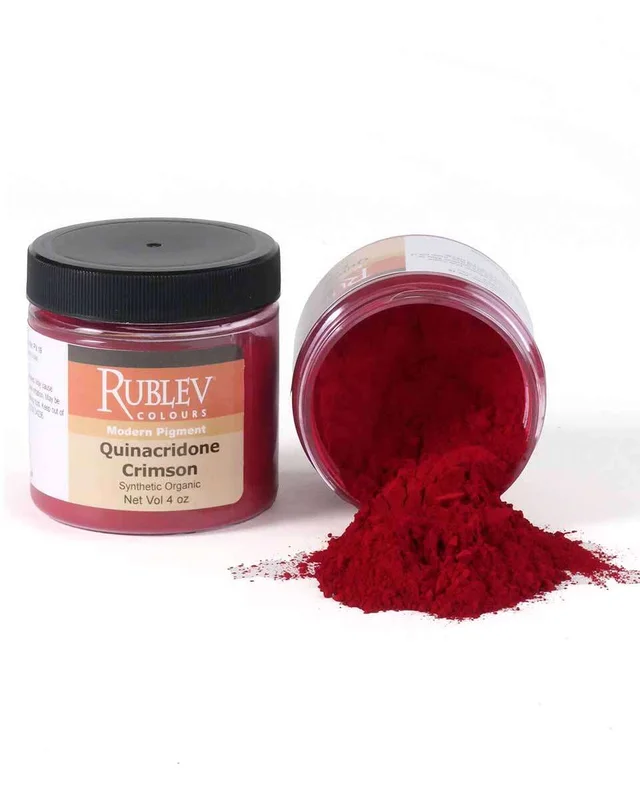
Quinacridone Crimson is a high‑chroma red‑violet pigment (C.I. Pigment Violet 19) prized for its exceptional lightfastness, clarity, and glazing power. In masstone, it appears a deep transparent crimson; in tints, it yields luminous rose and violet notes with very clean undertones. Suitable for oil, watercolor, acrylic, egg tempera, casein, distemper, and more. A workhorse “modern crimson” for historical and contemporary palettes.
| Pigment Names | |
|---|---|
| Common Names | Chinese: 喹吖啶酮深红 (Kuíyādīntóng shēnhóng) English: Quinacridone Crimson; Quinacridone Red-Violet; Quinacridone Violet French: Cramoisi de quinacridone German: Chinacridon-Karmin Italian: Cremisi di chinacridone Japanese: キナクリドン・クリムゾン (Kinakuridon Kurimuzon) Russian: Хинакридоновый кармин (Khinakridonovy karmin) Spanish: Carmesí de quinacridona |
| Synonyms | Pigment Violet 19; C.I. 73900; PV19; Quinacridone Violet; Quinacridone Red-Violet; Quinacridone Rose; Permanent Crimson (brand naming) |
Origin and History
Quinacridone pigments were commercialized in the late 1950s as high‑performance organics noted for their weathering, heat stability, and lightfastness. PV19 rapidly became the artist standard for clean red‑violet and “permanent crimson” mixtures, replacing many fugitive lake colors once used for rose and violet effects. Its balance of transparency, chroma, and permanence makes it one of the most widely adopted modern reds across media.
Source
Quinacridone Crimson is a synthetic organic pigment produced through controlled crystallization of quinacridone, yielding red‑violet shades with strong tinting strength and high purity. Grade‑to‑grade variations arise from crystal modification (β/γ forms) and surface treatment; these explain the range of trade names such as quinacridone violet, rose, crimson, and red‑violet while remaining within PV19.
Permanence and Compatibility
PV19 is broadly rated Excellent (ASTM I) for lightfastness in all artist painting mediums. It maintains chroma in mixtures, producing:
-
Brilliant violets with ultramarine and phthalo blues.
-
Luminous oranges with transparent yellows (e.g., PY150) for “permanent alizarin/crimson”‑type mixtures.
-
Natural rubies and dried‑rose tones, when moderated with earths, without turning muddy.
Chemically, PV19 demonstrates strong resistance to most solvents and binders typical of artists’ materials and is compatible with drying oils, aqueous binders (gum arabic, casein), and acrylic/alkyd systems.
Oil Absorption and Grinding
As with many fine organic pigments, PV19 has relatively high oil absorption and benefits from thorough pre‑wetting. Expect a soft, brushable paste with high transparency and strong tinting strength suited to glazing and optical mixing. Milling is straightforward once properly wetted; extended dispersion raises clarity and chroma.
Typical physical/processing benchmarks (grade‑dependent):
-
Hue angle (1/3 SD): ~356.9°
-
Reduction ratio (1/3 SD): ≈ 1:3.6
-
Reduction ratio (1/25 SD): ≈ 1:54.4
-
Specific surface area: ~74 m²/g
-
Oil absorption: ~64 ml/100 g
-
Bulk volume: ~2.8 L/kg
-
Density (apparent): ~1.5 g/cm³
-
Heat resistance: ~200 °C
Note: Values are reference data from a representative PV19 technical data sheet for Monolite Red 301901; actual values vary with grade and processing.
Toxicity
Quinacridone pigments are generally considered low-hazard in artists’ use. Avoid inhalation of dust and contact with eyes or mouth. Use appropriate PPE when handling dry pigment; maintain good studio hygiene. Not intended for cosmetic or food use.
Mixing & Application Notes
-
Glazing: Extraordinary depth in thin films; underpainting with transparent blues yields complex plums.
-
Neutral mixes: With phthalo green or complementary earths for near‑neutral darks that dry robustly.
-
Watercolor: Transparent, strongly staining; excellent for layered violets and floral hues; granulation minimal.
-
Acrylic/Casein/Tempera: Retains clarity; mixes cleanly without the dulling common to many lake reds.
What It’s Not
Do not confuse PV19 with PR122 (quinacridone magenta) or PR206/PR209 (quinacridone reds). PV19 sits slightly red‑violet of magenta and is the classic choice for permanent crimson mixtures in many brands.
Composition and Permanence
| Pigment Information | |
|---|---|
| Pigment Name | Quinacridone Crimson (Monolite Red 301901) |
| Pigment Classification | Synthetic organic |
| Colour Index | Pigment Violet 19 (C.I. 73900) |
| CAS Number | 1047-16-1 |
| Chemical Type | Quinacridone |
| Physical Properties | |
| Appearance | Red-violet powder; transparent in most binders |
| Density | ≈ 2.8 g/cm³ (true; reference PV19 grade) |
| Bulk Volume | ≈ 1.5 L/kg (reference PV19 grade) |
| Specific Surface Area | ≈ 74 m²/g (reference PV19 grade) |
| Oil Absorption | ≈ 64 ml/100 g (linseed oil) |
| Hue Angle | ≈ 356.9° (1/3 SD) |
| Reduction Ratios | 1/3 SD: ≈ 1:3.6 |1/25 SD: ≈ 1:54.4 |
| Refractive Index | = 2.02 = 2.04 |
| Fastness Properties | |
| Acid Resistance | Excellent (tested in typical alkyd/melamine systems) |
| Alkali Resistance | Excellent |
| Overpainting Compatibility | Excellent |
| Solvent Resistance | Water (5), Ethanol (5), n-Butyl Acetate (5), Xylene (5), MEK (5), White Spirits (5) |
| Heat Resistance | ≈ 200 °C (dry pigment) |
| Lightfastness | Full Shade: 8 1/3 SD: 7–8 1/25 SD: 7 |
| ASTM Lightfastness | |
| Acrylics: | I |
| Oils: | I |
| Watercolors: | I |
| Regulatory Compliance | |
| Regulations: | Germany BfR IX: Compliant; AP 89/1: Compliant; FDA 21 CFR §178.3297: Listed (details on request); EN 71-3 (Toy Safety, EU): Compliant; ASTM F963 (Toy Safety, USA): Available upon request; RoHS 2011/65/EU: Compliant; End-of-Life Vehicles Directive: Compliant. Verify per current SDS/TDS for the supplied lot. |
| Health & Safety | |
| Safety Information | Generally regarded as low hazard in artists’ use. Avoid inhalation of dust and contact with eyes or mouth. Use appropriate PPE when handling dry pigment; maintain good studio hygiene. Not for cosmetic or food use. |
Note: SD refers to Standard Depth, a metric used in pigment characterization to indicate color strength and tinting behavior in standardized reductions with white (typically titanium dioxide, TiO2). The ratios shown (e.g., 1/3 SD and 1/25 SD) are the pigment-to-white proportions that produce those standard depths. For Quinacridone Crimson PV19, the typical reduction ratios are 1/3 SD ≈ 1:3.6 and 1/25 SD ≈ 1:54.4, reflecting very high tinctorial strength even at high dilution. Hue angle values are reported at 1/3 SD and position this pigment in the red-violet quadrant. Values may vary with grade and processing; verify against the current TDS for the supplied lot.
For a detailed explanation of the terms in the table above, please visit Composition and Permanence.
Reviews
There are no reviews yet.