Description
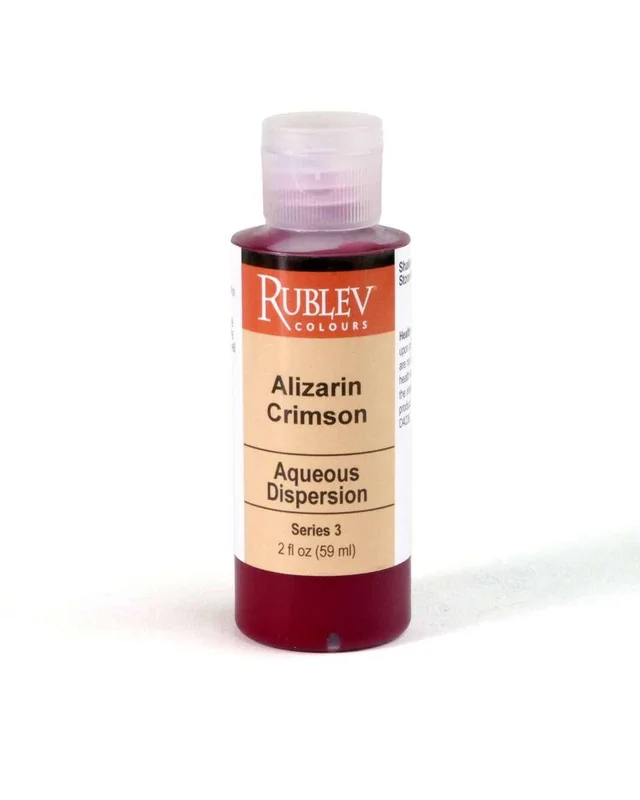
Alizarin crimson is very transparent, darker, warmer, and slightly browner in hue than quinacridone red. The pigment’s mass tone is much darker when leanly bound. Alizarin retains its warmth with dilution. The pigment is a lake of synthesized alizarin, the primary coloring component of rose madder, which it replaced. An extender pigment or glass can be added to emulate the natural lake pigment. Alizarin exhibits less than satisfactory lightfastness .
Rublev Colours Aqueous Dispersions are pigments dispersed in water ready to be mixed with water-based mediums. These dispersions are specially made for use with traditional painting mediums, such as egg tempera, casein tempera, fresco, watercolors, and distemper (glue tempera). They are also ideally suited for use with gesso to make toned grounds for drawing and painting. Pigment dispersions from Rublev Colours contain only naturally-derived ingredients, in addition to pigment and water, making them ideally suited for traditional mediums. Unlike other pigment dispersions that are typically made for acrylic medium, Rublev Colours Aqueous Dispersions do not contain coalescent solvents, artificial dispersing resins, and other additives that interfere with natural mediums. Aqueous Dispersions make preparing traditional mediums easy; you do not have to hassle with powders, grinding pigments in medium, and calculating binder ratios to make water-based paint. They make adding the right amount of paint binder, such as egg yolk, a no-brainer because the right amount of water is already contained in the dispersion; simply add egg yolk.
| Names | |
| Common Names (Dyestuff): | alizarin, alizarine, purpurin, Rubia tinctorum |
| Common Names (Pigment): | English: madder lake French: laque de garance German: Krapplack Italian: lacca di robbia Portuguese: laca de ruiva Russian: крапплак Spanish: laca de rubia |
Origin and History
The history of alizarin crimson begins with the madder plant. The natural red dye, made from the root of the madder plant, was first used as a dye thousands of years ago. It was also made into a pigment by fixing the dye onto a white powder, such as chalk and alum, to produce a lake pigment. The result is an insoluble pigment suitable for making paint. The history of the dye from madder root is discussed in Madder Lake.
In 1826, the French chemist Pierre-Jean Robiquet found there were two colorants in madder root, alizarin and the more rapidly fading purpurin. The alizarin component became the first natural dye to be synthetically duplicated in 1868 when the German chemists Karl Graebe and Karl Lieberman, working for BASF, found a way to produce it from anthracene. At about the same time, the English dye chemist William Perkin discovered the same synthesis, although the BASF group filed their patent one day before Perkin. Synthetic alizarin could be produced at less than half the cost of the natural product, and the market for natural madder collapsed virtually overnight. Alizarin itself has been largely replaced today by the more light-resistant quinacridone pigments developed at DuPont in 1958.
Source
Alizarin is produced through chemical synthesis and fixed onto aluminum hydrate.
Permanence and Compatibility
It is a beautiful transparent red but impermanent. Alizarin has similar lightfastness as madder lake and is known to fade within a few months of exposure to strong light, but the darker tones are more permanent. In fresco, lime destroys madder completely. In the original root, a second coloring agent called purpurin creates a superior permanence when removed. Madder lake requires about 70% binder, dries poorly, and should therefore be first mixed with linseed oil and ground with an addition of damar. It has been observed over time that madder lake bleeds, and when so, it has been an indication that it has not been used properly, perhaps too thickly in underpainting, or that it has been mixed with impermanent coal-tar dyes.
Madder lakes, especially those that contain little or no purpurin, have been well preserved in numerous European easel paintings, especially where it was employed as a glaze with another similar hue. Glazed over vermilion madder lake produces an intense cherry red unachievable by the direct mixture of paints. Vermeer used this glaze in the plumed hat of his painting The Girl with a Red Hat and in the satin gown in The Girl with a Glass of Wine, both very well preserved.
Oil Absorption and Grinding
The oil absorption of alizarin crimson is 59 grams of linseed oil to 100 grams of pigment. due to the ultra fineness of the pigment, it is difficult to disperse effectively without the aid of machinery.
Toxicity
Alizarin is considered to be non-toxic.
| Pigment Information | |
| Color: | Red |
| Colour Index: | Pigment Red 83 |
| Chemical Name: | Anthraquinone (1,2-dihydroxyanthraquinone) |
| Chemical Name: | C14H8O4, C14H8O5 |
| CAS No.: | 72-48-0 / 200-782-5 |
| ASTM Lightfastness Rating | |
| Acrylic: | III |
| Oil: | III |
| Watercolor: | IV |
| Properties | |
| Oil Absorption: | 59 grams oil / 100 grams pigment |
| Density: | 1.540 g/cm3 |
| Specific Gravity: | 1.7 |
| Bulking Volume: | 3.9 L/kg |
| pH: | 5.5–8.5 |
| Hardness: | – |
| Refractive Index: | 1.7 |
Reviews
There are no reviews yet.